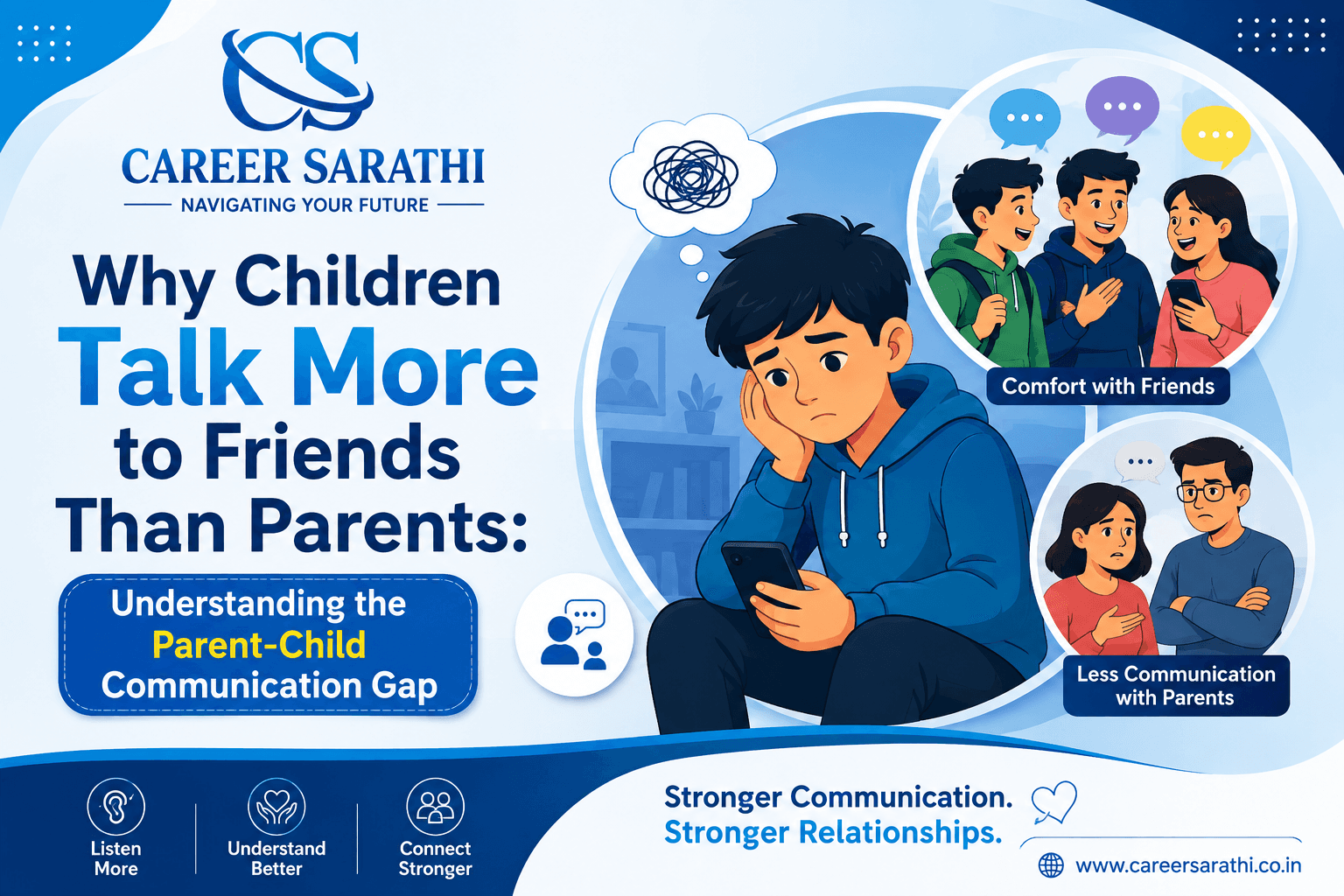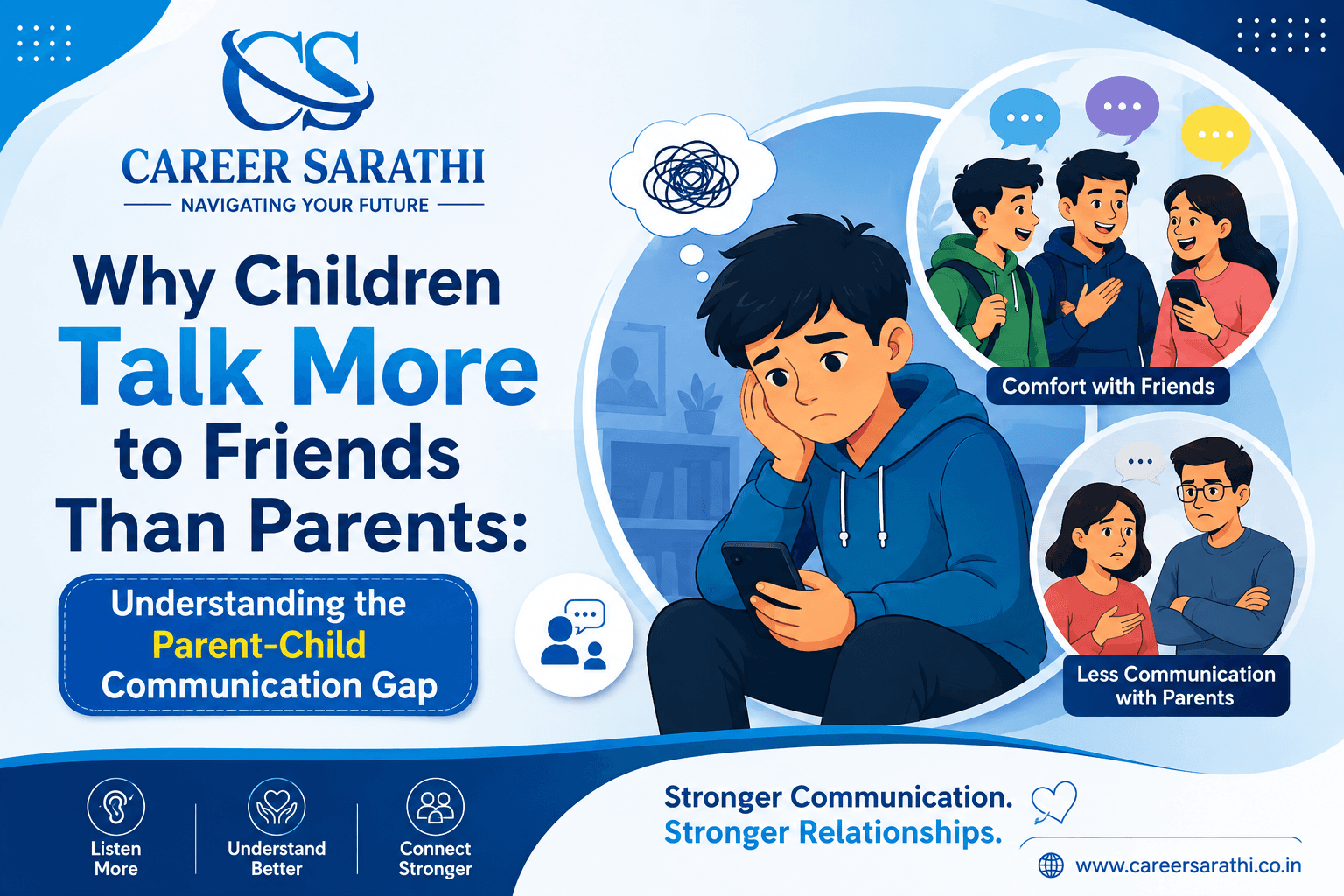
Why Do Children Become Less Open With Parents?
Children rarely stop communicating altogether. More often, they become selective about where, when and with whom they communicate.
Friends may feel easier to talk to because they share similar experiences. Teachers may sometimes provide a different kind of understanding because they interact with the child outside the family environment.
At home, however, conversations can unintentionally become centred around studies, discipline, screen time, behaviour and performance.
When most interactions involve instructions, corrections or questions about results, children may gradually begin to associate conversations with parents with pressure rather than connection.
This can create a communication gap over time.
1. Fear of Judgement Can Prevent Children From Opening Up
Children need to feel that they can express an opinion, concern or mistake without immediately being judged.
A child who expects criticism may think twice before sharing something personal.
For example, if every academic difficulty is interpreted as laziness, or every mistake becomes a lecture about responsibility, the child may eventually decide that keeping quiet is easier.
This does not mean parents should avoid correcting inappropriate behaviour. Children need boundaries and guidance. The important distinction is between correcting behaviour and judging the child.
Instead of labelling a child as careless, irresponsible or weak, parents can focus on understanding what caused the behaviour and what can be improved.
A child who feels respected is more likely to communicate honestly.
2. Children Often Need Listening Before Advice
Parents naturally want to solve their children's problems.
When a child shares a difficulty, the instinctive response is often to provide advice, identify the mistake and suggest a solution.
However, children do not always begin a conversation because they want an immediate solution.
Sometimes they simply want to be heard.
Effective communication often begins with listening without interruption.
Parents can ask open-ended questions such as:
1. What happened?
2. How did that make you feel?
3. What do you think about it?
4. What do you think would help?
5. Is there something you want me to understand?
Listening first does not mean agreeing with everything the child says. It simply creates an environment where the child feels safe enough to explain their perspective.
3. Too Much Advice Can Turn Conversations Into Lectures
A common communication pattern in families is that a simple conversation quickly becomes a lesson.
A discussion about school may become a lecture about marks. A conversation about friends may become a warning about distractions. A question about a hobby may become a discussion about academics.
When children repeatedly experience this pattern, they may start limiting what they share.
This is one reason parents should consciously create conversations that have no correction, instruction or performance expectation attached to them.
Not every conversation needs to teach a lesson.
Sometimes, simply talking about the child's interests, experiences, opinions and everyday life is enough to strengthen the relationship.
4. Fear of Parents' Reactions Can Lead to Silence
Children are more likely to hide information when they are uncertain about how their parents will react.
Anger, shouting, immediate punishment, excessive questioning or panic can discourage future communication.
This is especially relevant when children are dealing with sensitive issues involving friendships, academic difficulties, mistakes, social situations or personal concerns.
A calm first response can make a significant difference.
Parents can listen to the complete situation before deciding what action, if any, is necessary.
The objective is not to eliminate parental authority. It is to ensure that authority does not become a barrier to communication.
5. Comparison Can Damage Confidence and Openness
Comparison is another common reason children become reluctant to share their experiences.
Comparing a child with a sibling, friend, cousin or classmate may be intended as motivation, but repeated comparison can make children feel that their own efforts are never enough.
Every child develops differently. Academic ability, personality, interests, confidence, learning preferences and social skills can vary significantly from one child to another.
Rather than asking why a child is not like someone else, parents can focus on the child's individual progress.
Questions such as “What did you improve?”, “What did you find difficult?” and “How can we work on it?” encourage growth without creating unnecessary competition.
6. Parents May Know Their Child's Performance Without Knowing Their Experience
Parents often know a great deal about their child's external life.
They know their marks, school timetable, homework, tuition schedule, examination results and extracurricular activities.
But emotional connection requires a different kind of understanding.
Parents also need to know:
What their child worries about
What makes them feel confident
What makes them insecure
Which situations make them uncomfortable
What they enjoy doing
Who they trust
What they find difficult to communicate
What they wish their parents understood
There is a significant difference between knowing what your child is doing and understanding what your child is experiencing.
The second requires regular, meaningful communication.
7. Why Children Often Prefer Talking to Friends
Friendships become increasingly important during adolescence.
Children may feel comfortable discussing certain topics with friends because their peers may be experiencing similar situations. They may share the same school environment, social pressures, interests and concerns.
This is a normal part of growing up.
Parents should not necessarily view close friendships as competition for their child's attention.
Instead, healthy friendships can complement family relationships.
The objective is not to ensure that parents are the only people children talk to. Children benefit from having trusted friends, teachers and other supportive adults.
What matters is that parents remain among the people their child feels safe approaching when something important happens.
8. Teachers Can Become Trusted Adults
Teachers sometimes become people children are comfortable approaching because they provide a different kind of relationship.
A teacher may notice a child's abilities, encourage participation, listen to concerns or provide guidance in situations that parents may not directly observe.
If a child talks openly with a teacher, parents do not necessarily need to see this as a problem.
Instead, it can provide an opportunity to understand what makes the child comfortable communicating with that person.
Perhaps the child feels listened to.
Perhaps the teacher does not immediately judge them.
Perhaps the child feels that their strengths are recognised.
These observations can help parents improve their own communication at home.
9. Technology Has Changed Family Communication
Today's children have unprecedented access to communication.
Friends can be contacted instantly. Social media, messaging applications, online communities and digital entertainment occupy a significant part of their social environment.
The challenge is not technology itself.
The challenge arises when digital communication becomes more emotionally engaging than family communication.
If most conversations at home are limited to:
Study
Homework
Marks
Screen restrictions
Discipline
Daily responsibilities
while digital conversations provide entertainment, friendship and emotional connection, it is understandable that children may prefer the latter.
Parents therefore need to create meaningful offline interaction rather than focusing exclusively on restricting online interaction.
10. Adolescents Need Independence Along With Connection
As children grow, they naturally begin seeking greater independence.
They want personal space, their own opinions, privacy and greater control over their decisions.
Parents may interpret this as distancing or disobedience.
However, independence is an important part of growing up.
The challenge is finding the right balance between freedom and responsibility.
Children need to know that their parents respect their growing independence while remaining available when guidance or support is needed.
A healthy message is:
“You are growing up, and we respect your space. But whenever you need us, we are here.”
This creates connection without unnecessary control.
How Can Parents Improve Communication With Their Children?
Improving communication does not usually require a dramatic change.
It requires consistency.
Listen more than you speak
Allow your child to complete their thoughts before responding.
Ask instead of assuming
When behaviour changes, try to understand the reason before reaching a conclusion.
Avoid turning every conversation into advice
Some conversations can simply be conversations.
Separate the child from the behaviour
Correct inappropriate behaviour without making the child feel that they are fundamentally inadequate.
Reduce comparison
Measure progress against the child's own development rather than someone else's performance.
Respect growing independence
Give age-appropriate privacy and responsibility while maintaining appropriate boundaries.
Create regular opportunities to talk
Communication is easier when it is part of everyday family life rather than something that happens only when there is a problem.
What Should Parents Do When a Child Says, “Nothing”?
“Nothing” is a common answer from children and teenagers.
Sometimes it genuinely means nothing happened.
At other times, it may mean:
They are not ready to talk.
They don't know how to explain what they are feeling.
They are worried about the parent's reaction.
They expect criticism.
They simply want some space.
Repeated questioning may make the child withdraw further.
A better approach is to leave the door open:
“That's okay. If you ever want to talk about it, I'm here.”
The child may not respond immediately.
But they will remember that the opportunity to talk was available.
Building a Relationship Before There Is a Problem
One of the most important principles of parent-child communication is that trust cannot be created only during difficult situations.
If meaningful conversations happen regularly, children are more likely to approach parents when they encounter a serious problem.
Parents can build connection through simple everyday activities:
Having meals together
Going for a walk
Discussing interests
Watching something together
Talking about school experiences
Asking for the child's opinion
Sharing appropriate experiences from their own lives
These moments may appear ordinary, but they create familiarity and trust.
Strong communication is built gradually.
When Parents Need Additional Guidance
There are situations where parents may genuinely feel unsure about how to respond to their child's changing behaviour.
Persistent withdrawal, frequent conflict, significant changes in behaviour, declining confidence, academic difficulties, excessive digital dependence or difficulty communicating can leave parents wondering what approach is appropriate.
Seeking professional guidance in such situations is not an indication of poor parenting.
It can simply mean that the family wants to understand the situation more objectively and develop a constructive way forward.
Career Sarathi works in the broader area of student development and parent guidance, helping families understand children beyond academic performance and supporting healthier conversations around their development, strengths, challenges and future.
For parents who feel that they need a structured perspective on their child's development, Career Sarathi provides a starting point for exploring appropriate guidance and support.
The Goal Is Not to Become Your Child's Best Friend
Parents sometimes feel they need to become “friends” with their children to improve communication.
That is not necessarily the goal.
Children need parents to provide things that friends cannot always provide:
Stability.
Boundaries.
Experience.
Perspective.
Support.
The objective is to create a relationship where a child can disagree with a parent, make a mistake, ask a difficult question or share a concern without fearing rejection or humiliation.
A strong parent-child relationship does not mean there are no disagreements.
It means disagreements do not destroy trust.